Built by a Businessman, Loved by Everyone: The Strange, Sweet Story of Karataş's Asansör
There's a joke locals make that the Asansör is the only elevator in the world where nobody's in a hurry. Stand in the queue at the base of the tower in Karataş and you'll see it: couples arguing playfully about who gets the window side, teenagers filming the doors for their social feeds, a grandmother shooing everyone aside so she can step in first — which, everyone silently agrees, is her right.
It's a two-minute ride. Maybe less. And yet this creaking, iron-boned elevator between two old stone towers has somehow become the beating heart of Izmir's romantic imagination. The story of how that happened is stranger than the postcards let on.
A Favor Between Neighbors, Scaled to Architecture
Start with the origin, because it's genuinely one of the sweetest backstories in Turkish urban history. In the early 1900s, the Karataş neighborhood was split in two by a sheer cliff — roughly 58 meters of it. Down below sat the seafront street and the Jewish quarter's lower reaches. Up top sat the rest, including the home of a woman named Şerife Hanım.
The story goes that a Jewish businessman named Nesim Levi Bayraklıoğlu, whose shop stood at the top of the cliff, kept watching this elderly neighbor make the brutal climb up and down the 155-step staircase connecting the two levels. At some point he'd apparently had enough and decided to do something about it — not for profit, not for the city, but because watching your neighbor struggle up the stairs every day gets to you eventually.
So in 1907, he built an elevator. A real one, powered initially by steam, later by electricity, housed in a tower he commissioned from a French architect. He even paid for it out of pocket for years before handing it over to the municipality. The building's inscriptions — one in Hebrew, one in Ottoman Turkish — still mark the corners, a quiet record of a city that was, at the time, a swirl of Jewish, Greek, Armenian, Muslim, and Levantine communities living shoulder to shoulder.
If you're American, think of it this way: imagine someone getting so tired of watching his neighbor haul groceries up a San Francisco hill that he builds her a funicular. That's the energy.
The Mosaic That Grew Around It
Karataş itself deserves a moment. This was one of the densest Jewish neighborhoods in the old Ottoman Empire, and the area around the Asansör still carries that imprint — the Beth Israel Synagogue a short walk away, old Sephardic family names on doorbells, bakeries whose recipes predate the Republic. Waves of migration over the decades added their own layers: families from the Aegean interior, later arrivals from Anatolia's east, all folding into the same narrow streets.
The elevator sat at the hinge of all of it. It wasn't a monument; it was infrastructure. Fishermen rode it down at dawn, kids rode it up to school, merchants hauled goods between the two levels. For most of the twentieth century it was simply how the neighborhood worked — the way a subway turnstile is how a neighborhood works. Nobody photographed it much. They just used it.
The shift to landmark happened gradually, the way these things do. The staircase got famous too — the steep steps running alongside the tower now carry murals and street art, and climbing them became a minor rite of passage for anyone who wanted to claim they'd really seen Izmir.
Sunset Is a Reservation-Only Event
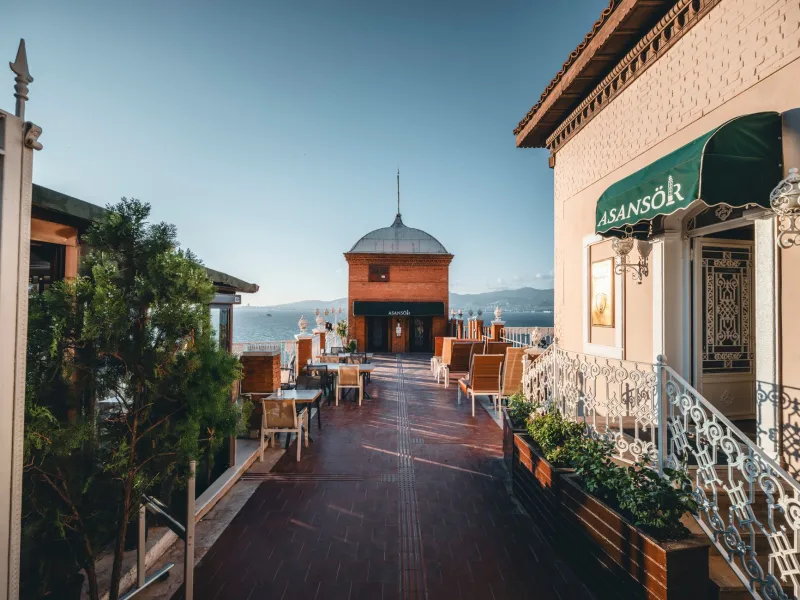
Here's what the guidebooks undersell: the top of the Asansör connects directly to a terrace café, and that café has arguably the single best vantage point in the city. You look out over the rooftops of Karataş, past the old hospital complex, all the way to the Aegean, which turns the color of hammered copper around 7 p.m. in summer.
Which means sunset is a land-grab. Locals know to arrive early, order a çay or an Turkish coffee, and treat the terrace like their own living room. There's an unspoken etiquette — you don't linger over one drink for three hours at peak time, and you don't sprawl across a four-top when it's just you and your phone.
And the ride itself? It's old. It hums and shudders in a way that would fail any American elevator inspection, and that's precisely the charm. Strangers get pressed together in the small cabin, and there's a weird intimacy to it — you ascend a cliff face with five people you'll never see again, everyone stealing glances at the same widening view through the window.
Ask anyone in Izmir and they'll tell you the real magic is sharing that ride at golden hour with someone you don't know. Half the city's love stories, if you believe the locals, have passed through that cabin.
How to Do It Right
A few practical notes for the curious:
- It's free. The ride costs nothing. This is the legacy of the original arrangement — a gift that never stopped being one.
- Take the stairs down, the elevator up. Or the reverse if your knees insist. The mural staircase is worth the walk either way.
- Go an hour before sunset, claim a terrace table, and order slowly. The view does the rest.
- Wander the neighborhood after. Karataş rewards aimlessness — old façades, corner bakeries, the seafront promenade at the bottom.
There's something fitting about the whole thing. An elevator built out of neighborliness became a city's favorite place to fall in love. In a century of change — empires collapsing, communities dispersing, the coastline transformed — the Asansör just keeps running, up and down, exactly as intended.
İzmir has flashier landmarks. It has older ones. But none of them were built because one man got tired of watching his neighbor struggle. That's the part that sticks with you — and the part that makes the two-minute ride worth standing in line for.