Three Days, One Village, Zero Timeline: What an Aegean Wedding Outside Izmir Really Looks Like
The drummer starts at 10 a.m. sharp, which is to say, whenever he feels like it. By the time he reaches the village square in a small Aegean town I've agreed not to name — the family asked, half-joking, that we keep it 'ours' — a crowd of maybe two hundred has fallen in behind him. Aunties in floral headscarves. Teenagers filming vertical video. A bewildered American couple in linen who clearly read the same blog post I did.
This is day two of a wedding. It started Thursday. It will not properly end until Saturday night. And it is happening, keep in mind, a 45-minute drive from a city of four million people with a tram system, a symphony, and third-wave coffee shops that would pass for anything in Portland.
The Wedding Is Not an Event. It's a Season.
If your mental model of a wedding is a single day with a rigid schedule — ceremony at 4, dinner at 6, everyone home by 11 — an Aegean village wedding will break it in the first hour. Here, the wedding is closer to a harvest: something the whole community gathers around, contributes to, and gradually consumes over days.
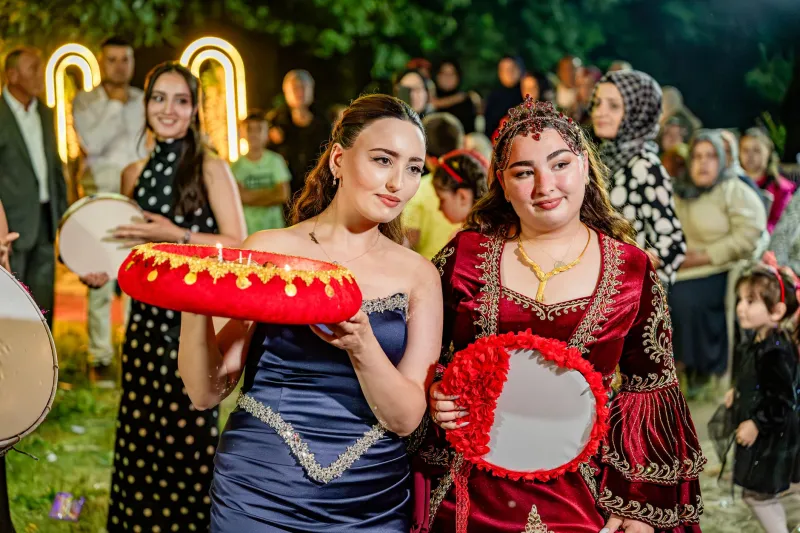
It begins with the kına gecesi, the henna night, held the evening before the bride is 'handed over.' Think of it as a bachelorette party, except instead of sashes and karaoke, there's a single lit candle carried through a darkened room, mournful folk songs with lyrics that would make a country ballad look cheerful, and a grandmother who places henna in the bride's palm while wrapping her hands in red embroidery. The bride is supposed to cry. Many do, genuinely. The henna stains her palms for the next week — a public announcement, wherever she goes, that she was recently a bride.
When I ask a cousin named Sevil whether young people still want this, she laughs. 'In the city? They do a DJ version. Here, the songs have verses. The verses have meanings. You can't rush it.'
Day Two: The Whole Village Cooks
The next morning belongs to the women — and to the sahan, the enormous hammered-copper pan that only comes out for weddings and festivals. In a courtyard behind the family house, a rotating crew of neighbors stirs rice pilaf with a wooden paddle the size of a canoe oar. Someone is frying dough for lokma, the sweet fried dough balls that get handed out to anyone who wanders past. Nobody is being paid. Nobody is keeping score. This is simply what you do when it's Ayşe's son's wedding, because it was done for yours.
Meanwhile, the men have a separate, equally serious operation: slaughtering, grilling, and arguing about fire management. The smoke alone functions as an invitation. People drift in who are, as far as I can tell, related to no one, and are fed without question.
For American readers, the closest thing might be a Southern church homecoming or a Hawaiian luau — food as a communal act rather than a catered service. But even those usually happen in a day. Here the cooking itself is the entertainment.
The Procession, or: How to Collect a Bride With a Drum Line
By late afternoon, the groom's side forms a dügün alayı — a wedding procession — and walks, dances, and occasionally struts through the village to collect the bride from her family home. The davul drummer leads. Zurna players (think oboe meets fire alarm, in the best way) follow. Everyone behind them does a shuffling line dance called the halay, hands linked with handkerchiefs, that seems to have no fixed step and every possible step.
It is loud. It is slow. It stops for tea. It stops when an elderly neighbor comes to her gate and must be greeted. The procession might take an hour to cover a distance you could walk in ten minutes, and that is entirely the point — the delay is the celebration.
At the bride's house, her brother or uncle literally ties a red ribbon around her waist, a symbolic farewell, and the room dissolves into more of those aching folk songs. Then she is walked out, often to the sound of firecrackers and car horns, and the whole parade reverses toward the party.
The Night That Doesn't Have a Last Call
The wedding night itself is held outdoors — a rented field, strings of lights, plastic chairs, a stage for the band. The music is otsak folk at first, then inevitably some pop, then an uncle with a wireless mic. Kids run feral until they fall asleep in chairs. Elders dance a slow, dignified two-step that teenagers mock and then, three hours later, join.
Money is pinned on the groom's suit — a festive donation ritual called takı — and a small, good-natured competition breaks out over who pins the largest bill. Nobody leaves early. Nobody checks the time. The band plays until the dancers are gone, not until the contract says so.
Why 'Authenticity' Tourists Keep Showing Up
Here's the slightly uncomfortable truth the American couple in linen admitted to me over lokma: they found this wedding through a cultural travel Facebook group, were invited by a cousin-of-a-cousin, and came partly because they were tired of 'experiences' that had a gift shop at the end.
And it's fair to be skeptical of that instinct — treating someone's family milestone as content. But watching it happen, I kept thinking the skepticism misses something. Nobody performed for the visitors. The grandmother didn't slow the henna ceremony for photos. The village simply absorbed them the way it absorbs everyone: a chair, a plate, a hand to shake.
That's the thing about these weddings, an hour outside Izmir. They aren't preserved for tourists. They persist because they still work — because a community that cooks together, dances together, and doesn't believe in last calls turns out to be a pretty durable thing. The metropolis is close enough to see on a clear day. It just can't hear the drums over its own noise.
If you're ever lucky enough to be invited: bring nothing, eat everything, and learn the word 'halay' before you go. Your feet will figure out the rest.