Dice, Tea, and Trash Talk: Inside Izmir's Serious Obsession With Backgammon
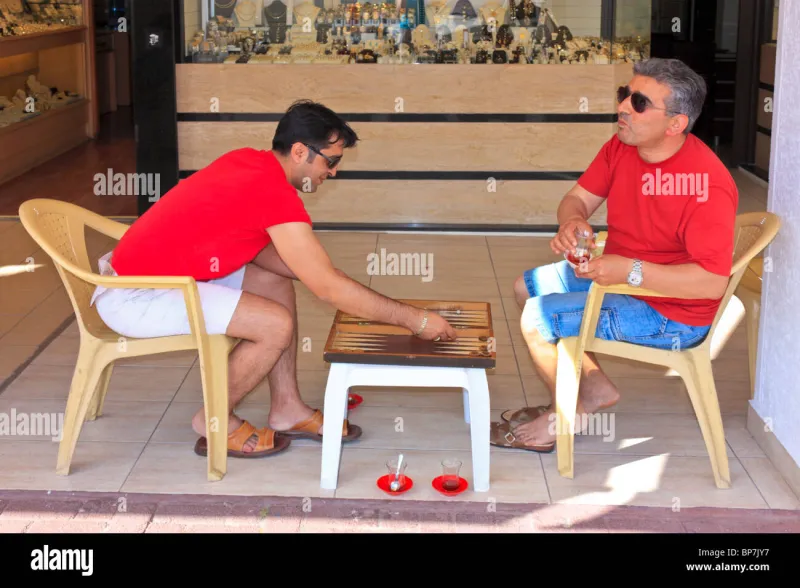
Photo: backgammon board tea garden Turkey men playing tavla outdoor cafe, via c8.alamy.com
Picture this: it's 4 p.m. on a Tuesday, the Aegean is doing its best glass-tabletop impression, and every single table at a seaside tea garden in Karşıyaka has the same thing on it — a glass of tea, a couple of sugar cubes, and a wooden backgammon board folded open like a book mid-chapter.
If you've spent any time in Izmir, you've seen it. Tavla — backgammon, to Americans — isn't a hobby here. It's infrastructure. It's how retirees stay sharp, how uncles settle arguments, how friendships get maintained without anyone having to admit they missed each other.
The Board Is the Small Talk
Here's what throws off American visitors: nobody in Izmir asks "do you want to play?" They just start setting up the board. That's the invitation. The game is the conversation.
Mehmet Bey, 71, has held court at the same tea garden near the Kordon for over two decades. "We don't need a topic," he told me, mid-match, without looking up from the dice. "The board gives you something to do with your hands while you say what you actually mean."
He's not wrong. Watch any tavla match in this city and you'll notice the game and the gossip run on parallel tracks. A brutal dice roll gets answered with a story about a son-in-law. A clever double hit earns a raised eyebrow and a refill of tea. The checkers are almost secondary — almost.
Reading a Match Like a Local
Want to spectate without looking lost? A few pointers:
- Listen for the dice. A double six ("şeş"!) gets announced like a lottery win. A run of bad rolls gets a theatrical sigh that could power a wind turbine.
- Watch the board flip. When a player folds the board upright — checkers rattling like a maraca — that's a declaration. Either the game's over or someone's feelings are.
- Respect the pause. Long silences between moves aren't awkwardness. They're strategy. Interrupt one at your peril.
And if someone offers to "teach you a quick game," understand that this is both a kindness and a trap. You will lose. Repeatedly. The only acceptable response is to ask for another round.
The Unwritten Rulebook
Officially, tavla has rules. Unofficially, Izmir has etiquette, and it's stricter than any tournament handbook:
- Never blow on the dice. That's a casino move. This is a tea garden.
- The loser sets up the next board. No exceptions, no sulking.
- You may comment on your opponent's luck. You may not comment on their skill. That's what the board is for.
- Tea is mandatory. Playing dry is considered mildly antisocial.
There's also the matter of kırma — the opening move where you sacrifice a checker early to build position. Some players treat it as pure math. In Izmir, it's practically a philosophical statement. Ask two regulars about the right way to open and you'll get two forty-minute lectures.
Not a Game, a Network
Here's the argument this article is legally obligated to make: the tavla board is Izmir's original social network. No algorithm, no notifications — just dice, proximity, and the daily commitment of showing up at the same table at the same time.
For retirees especially, the tea garden board is the day's anchor. It's where news travels, where favors get brokered, where a widower named Süleyman has been slowly, over eleven years, being set up with a widow from Buca by a table of self-appointed matchmakers who lose to him regularly and consider it a fair trade.
Younger players have their own circuit, too — cafés in Alsancak where students play between classes, phone timers replacing the old egg-timer rhythm, but the trash talk remains fully traditional.
Try It Yourself
Plenty of tea gardens around Konak, Karşıyaka, and Bornova will happily hand a beginner a board, especially in the late afternoon when the regulars are in a generous mood. Bring patience, order a çay, and prepare to be corrected.
Because in Izmir, the fastest way into the community isn't a party invitation or an introduction. It's a roll of the dice and someone across the table saying, in effect, you're with us now.